
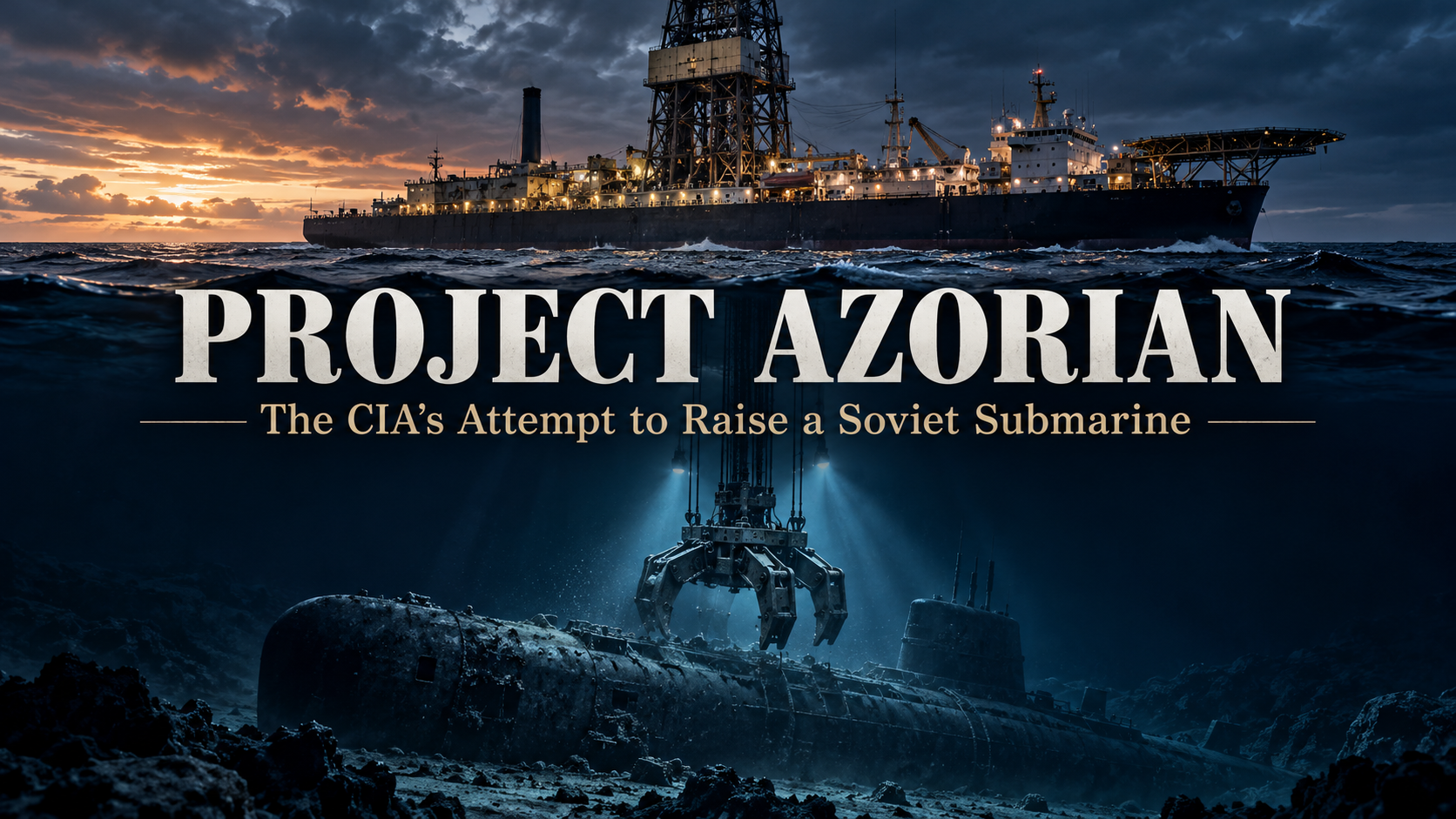
Cover image: AI-generated editorial illustration created for The Strategic Current; artistic reconstruction, not an archival photograph of Project Azorian. AI and editorial technology information.
In the summer of 1974, a vessel presented to the world as a deep-ocean mining ship took position above a Soviet submarine wreck in the Pacific. The Hughes Glomar Explorer carried machinery capable of reaching more than three miles beneath the sea. Its real customer was the Central Intelligence Agency, and its mission was not to harvest manganese nodules. It was to recover part of K-129, a Soviet ballistic-missile submarine lost in 1968 (Central Intelligence Agency [CIA], n.d.; Project Azorian mission proposal, 1974).
The operation, known as Project Azorian, has often been remembered as either a brilliant intelligence coup or an enormously costly disappointment. Both descriptions hide a crucial distinction. The engineering system successfully brought part of the wreck aboard, but the publicly available record does not establish a complete inventory of the intelligence that resulted. What the United States hoped to recover, what its equipment physically retrieved, and what analysts could ultimately exploit are three separate questions.
Background: A valuable wreck at an extraordinary depth
K-129 disappeared during a Pacific patrol in March 1968. After Soviet search efforts failed, the United States located the wreck on the seafloor at roughly 16,500 feet. The submarine was a potential source of intelligence about Soviet naval technology and strategic weapons. Yet finding its location did not answer whether an intact and useful section could be lifted from such extreme depth (CIA, n.d.; Project Azorian mission proposal, 1974).
The United States was evaluating a difficult opportunity amid Cold War competition and an evolving diplomatic relationship with Moscow. Recovery might yield equipment that would otherwise be inaccessible. It also carried engineering, security, diplomatic, and financial risks. The intelligence value could not simply be measured by the submarine’s presence on the ocean floor: sensitive materials would have to survive the sinking, the environment, recovery, and subsequent analysis.
A May 23, 1974 memorandum signed by Director of Central Intelligence William Colby makes the conditional nature of the case unusually clear. The United States Intelligence Board viewed possible cryptographic materials, missile components, weapons information, and documents as valuable targets. It explicitly assumed a successful recovery and exploitation; it was evaluating potential intelligence value, not reporting what the mission had already achieved (Colby, 1974).
Analysis: Building a mining ship for an intelligence mission
The CIA’s response to the engineering problem was a purpose-built heavy-lift ship. Under the public cover of deep-ocean mineral research connected to Howard Hughes, the Hughes Glomar Explorer could be equipped with specialized machinery that might otherwise attract attention. The May 28 mission proposal called it an ostensibly commercial mining vessel and referred to extensive tests, crew training, and the narrow operational window (Project Azorian mission proposal, 1974).
Cover and engineering reinforced one another. A conventional naval recovery platform would have been conspicuous. A vessel claiming to test deep-sea mineral extraction could more plausibly carry unusual cranes, piping, and processing machinery. The cover story was not evidence that commercial mining was the real task; rather, its apparent plausibility helped give the recovery team room to work (CIA, n.d.; Thulin, 2019).
Even the choice of how to move the equipment was shaped by secrecy. The capture vehicle—a giant mechanical gripping structure—was designed to reach the wreck and hold its weight during the ascent. The Glomar Explorer had a large internal docking well, sometimes called a moon pool, through which the recovered object could be hidden from observers. CIA historical accounts describe a submerged barge transfer that allowed the capture equipment to enter the ship without a public display (CIA, n.d.).
The machinery presented an extraordinary systems-integration challenge. The American Society of Mechanical Engineers identifies the ship’s center well, hydraulic hoist, long tapered lift-pipe string, motion compensation, and articulated capture device as significant engineering innovations. These systems had to work together in open-ocean conditions, with a moving surface ship controlling equipment operating far below it (American Society of Mechanical Engineers [ASME], n.d.).
That technical assessment has limits. ASME’s history is strong evidence for the engineering system and its professional recognition, but its entry gives a different month for K-129’s loss than the contemporary U.S. records. This article therefore uses the archival record for the submarine’s March 1968 disappearance and the ASME account for the machinery it specifically documents.
The attempted lift: A partial physical success
The CIA Museum dates Glomar Explorer’s arrival at the recovery site to July 4, 1974. During the ensuing operation, the ship lowered its capture vehicle to the wreck, secured a section, and began a difficult ascent by recovering the lift pipe piece by piece. The CIA account says the load broke apart partway up and a substantial section fell back to the seabed (CIA, n.d.).
A contemporary document offers an unusually valuable check on that later story. At a National Security Council meeting on August 10, 1974, Colby told President Gerald Ford that the gripping device had been damaged and part of the submarine had been lost. He said the remainder was aboard the recovery ship, which was steaming away from the site. He also cautioned that it could take considerable time to learn exactly what the team had recovered (Minutes of a National Security Council meeting, 1974).
This matters because the 1974 meeting is not a polished retrospective. It records senior officials dealing with a partial operational success and uncertain exploitation immediately afterward. It documents an actual recovered section without demonstrating that a full intelligence objective was satisfied. By contrast, a pre-mission valuation that listed hoped-for equipment cannot verify post-mission possession of that equipment.
The recovered section also contained the remains of six Soviet submariners. They were given a formal military burial at sea, and a recording of the ceremony was later delivered to Russia. The operation was an intelligence mission, but the people aboard K-129 were casualties of a submarine loss, not merely background to a technological achievement (CIA, n.d.; Aid et al., 2010).
What intelligence did the United States actually obtain?
The public record supports a narrow answer. It establishes the collection objectives, the partial lift, and contemporary uncertainty about how useful the recovered contents would prove. It does not establish that the United States obtained every codebook, warhead component, or missile item envisioned in the May 1974 assessments. The still-redacted record leaves important aspects of subsequent technical and intelligence exploitation outside public view (Colby, 1974; Minutes of a National Security Council meeting, 1974).
CIA retrospectives describe Azorian as an important Cold War intelligence operation despite its failure to achieve every objective. They credit its engineering and the intelligence it contributed. That is a relevant institutional assessment, but it is not a complete independently published accounting of recovered artifacts (CIA, n.d.).
Captain Jack G. Newman, a participant in Azorian, offered a sharper assessment in a December 2025 account for Naval History. He described no recovered cryptographic manuals or equipment and characterized the mission as an intelligence disappointment, even while celebrating its engineering achievement. His technical recollection is a meaningful firsthand perspective, not a substitute for a fully declassified exploitation report (Newman, 2025).
Smithsonian writer Lila Thulin, reporting on an International Spy Museum exhibition, described how competing accounts and continuing classification complicate definitive judgments. Some narratives emphasize the loss of the most valuable section; others urge caution about claims that the mission yielded little. The responsible conclusion is not to choose the most dramatic possibility. It is to preserve uncertainty where underlying evidence has not been released (Thulin, 2019).
There is also a terminology trap. The operation was called Azorian; “Jennifer” was associated with its special security compartment. The National Security Archive’s 2010 editorial examination of the declassified CIA history explains why confusing the two produces a misleading history (Aid et al., 2010).
Strategic implications: Secrecy, technology, and diplomacy
Azorian involved more than a specialized ship. It linked industrial contractors, intelligence planning, executive authorization, maritime logistics, and diplomatic risk. The mission’s cover had to survive publicity about an unusual vessel, the scrutiny of nearby Soviet ships, and the possibility that any accident might expose the operation before the recovery was complete (Project Azorian mission proposal, 1974; CIA, n.d.).
The public story unraveled in stages. The CIA dates a burglary involving a Hughes-associated office to June 1974. Journalistic investigation and government efforts to limit disclosure followed. A Los Angeles Times account appeared in February 1975, with further national reporting in March. Subsequent exposure undermined plans to retrieve the portion lost during the first lift (CIA, n.d.; Aid et al., 2010).
The affair also influenced the language of government secrecy. In litigation over records relating to the project, the CIA argued it could neither confirm nor deny the existence of the requested information. That position became widely known as the “Glomar response.” The National Security Archive traces the term to the resulting Freedom of Information Act dispute, while cautioning that later declassification did not erase all remaining secrets (Aid et al., 2010).
The strategic consequence lies in the interaction of technical success and political exposure. A capability built with extraordinary resources may depend on a narrow window of secrecy. If that window closes, even a successful system may not get a second chance to meet the original intelligence objective.
Lessons learned: Judge each outcome on its own evidence
First, engineering feasibility and intelligence value are not the same metric. ASME’s recognition of the ship’s innovations is evidence of a meaningful technical achievement. It does not prove which sensitive documents or weapon components were recovered (ASME, n.d.; Colby, 1974).
Second, intelligence objectives should be written as objectives until records establish results. A memorandum explaining why cryptographic materials would be useful is strong evidence of planning priorities, but weak evidence of the eventual haul. The August 1974 briefing provides a better near-contemporaneous account of the physical outcome and the uncertainty that followed (Minutes of a National Security Council meeting, 1974).
Third, apparently contradictory sources may be answering different questions. A participant can assess what was seen during exploitation, an agency historian can describe an operation’s institutional significance, and a technical society can document design innovations. Readers need to know whose perspective is being summarized and what that source can actually verify (Newman, 2025; CIA, n.d.; ASME, n.d.).
Conclusion: An extraordinary lift, an incomplete public answer
Project Azorian accomplished something rare: a covert, partial lift of a Soviet submarine wreck from the deep Pacific, using machinery built around an elaborate commercial disguise. The contemporary record confirms both the physical recovery and the damage that prevented a complete lift. The mission also reached beyond the ship itself, shaping later intelligence historiography and public-records practice.
Its final intelligence value remains harder to measure from unclassified evidence. Treating the operation as a total failure overlooks what was physically accomplished; calling it a complete intelligence triumph reaches beyond the material available to readers. Azorian’s enduring lesson is that ambitious intelligence operations must be evaluated with separate standards for engineering, collection, exploitation, and the quality of evidence used to describe them.
Sources and Additional Information
- Aid, M., Burr, W., & Blanton, T. (2010, February 12). Project Azorian: The CIA’s declassified history of the Glomar Explorer. National Security Archive. https://nsarchive2.gwu.edu/nukevault/ebb305/
- American Society of Mechanical Engineers. (n.d.). Hughes Glomar Explorer (Historic Mechanical Engineering Landmark No. 239). https://www.asme.org/about-asme/engineering-history/landmarks/239-hughes-glomar-explorer
- Central Intelligence Agency. (n.d.). Project AZORIAN. CIA Museum. https://www.cia.gov/legacy/museum/exhibit/project-azorian/
- Colby, W. E. (1974, May 23). Memorandum from the chairman of the United States Intelligence Board to the chairman of the 40 Committee (Document 185). In Foreign relations of the United States, 1969–1976, Vol. XXXV. U.S. Department of State, Office of the Historian. [Original memorandum; digital archival edition.] https://history.state.gov/historicaldocuments/frus1969-76v35/d185
- Minutes of a National Security Council meeting. (1974, August 10). (Document 190). In Foreign relations of the United States, 1969–1976, Vol. XXXV. U.S. Department of State, Office of the Historian. [Original meeting record; digital archival edition.] https://history.state.gov/historicaldocuments/frus1969-76v35/d190
- Newman, J. G. (2025, December). Inside Project Azorian. Naval History, 39(6). U.S. Naval Institute. https://www.usni.org/magazines/naval-history/2025/december/inside-project-azorian
- Project Azorian mission proposal. (1974, May 28). Memorandum to the chairman of the 40 Committee (Document 186). In Foreign relations of the United States, 1969–1976, Vol. XXXV. U.S. Department of State, Office of the Historian. [Original memorandum; digital archival edition.] https://history.state.gov/historicaldocuments/frus1969-76v35/d186
- Thulin, L. (2019, May 10). During the Cold War, the CIA secretly plucked a Soviet submarine from the ocean floor using a giant claw. Smithsonian Magazine. https://www.smithsonianmag.com/history/during-cold-war-ci-secretly-plucked-soviet-submarine-ocean-floor-using-giant-claw-180972154/
Continue the analysis
Read more evidence-based analysis at The Strategic Current: https://thestrategiccurrent.com. Follow The Strategic Current for further reporting on history, security, and strategic affairs.
Copyright and editorial attribution
© 2026 The Strategic Current. All rights reserved. Original editorial material only; third-party sources and archival materials retain their respective rights.
AI Disclosure
AI-Assisted Content Disclosure: This article was prepared with the assistance of generative artificial intelligence. AI was used to help organize, draft, edit, and refine the article based on the supplied research materials. The underlying historical research and sources were provided for this article, and the final text was reviewed and edited for publication. AI assistance does not constitute an endorsement by any source, institution, or individual referenced in this article.
AI limitations: While care was taken to verify information, AI tools can introduce errors; readers are encouraged to consult original sources. If any discrepancies in this information are identified, please email [email protected] for immediate correction.
U.S. Copyright Office. Copyright and Artificial Intelligence: Part 2—Copyrightability. https://www.copyright.gov/ai/