
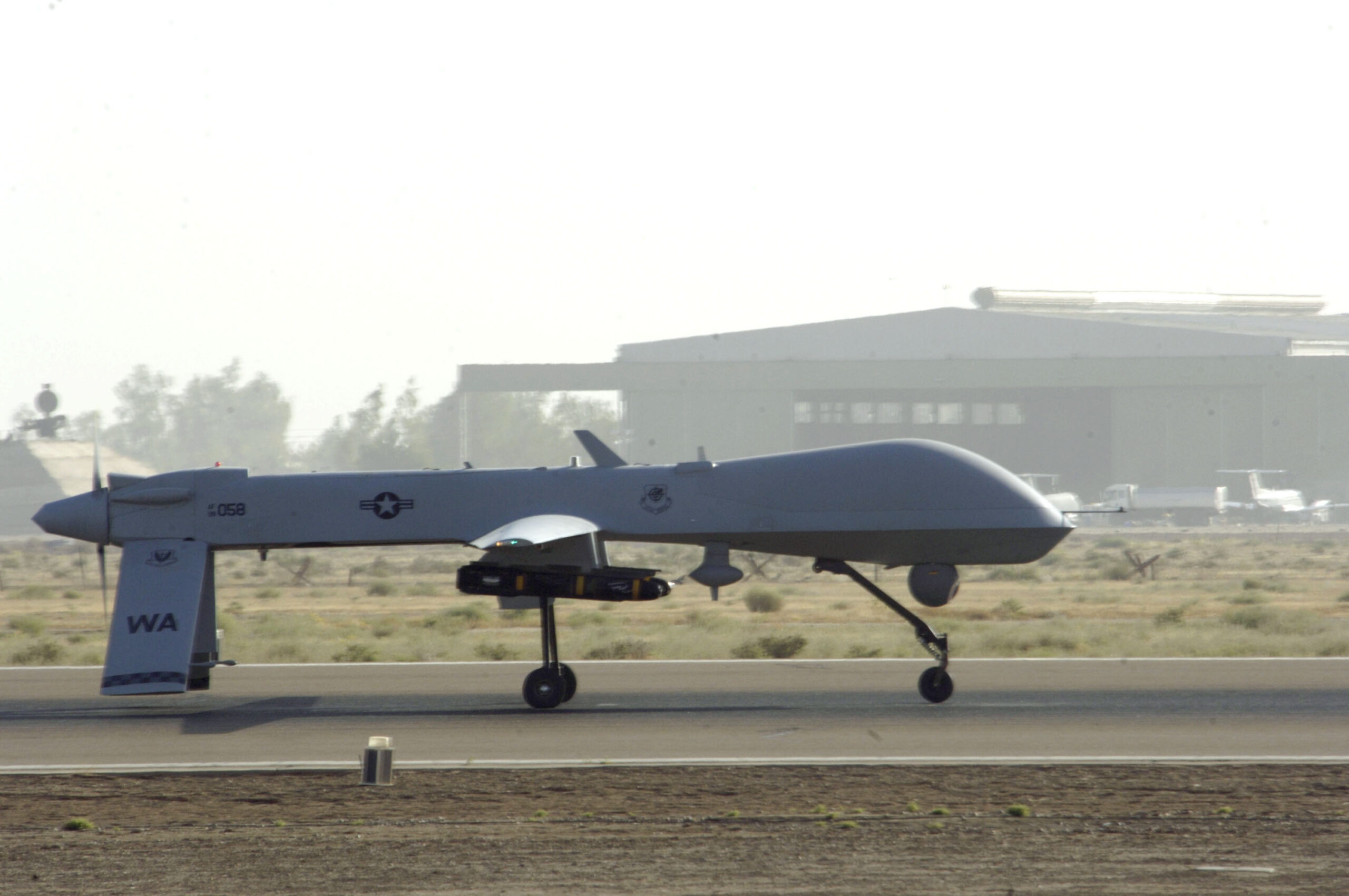
Cover image: U.S. Air Force MQ-1 Predator at Balad Air Base, June 14, 2006; photograph by Airman 1st Class Andrew Oquendo (U.S. public domain). Original image and rights.

Introduction
Before the Predator carried missiles, its job was to watch.
The aircraft was designed to give American commanders something they had long wanted: a persistent view of events on the ground without keeping a pilot inside the aircraft. It could follow activity, gather intelligence, and help military personnel understand what was happening over considerable distances.
But watching and acting were two different things.
A Predator might identify a potential target without being able to engage it. That information still had to reach the appropriate people, be evaluated, and potentially be passed to another aircraft or weapons system. In an operation where circumstances could change quickly, those additional steps mattered.
The decision to arm the Predator challenged that separation.
By adapting a reconnaissance platform to carry AGM-114 Hellfire missiles, the U.S. military helped establish a new model of remotely piloted operations. An aircraft developed to observe could also participate directly in a strike.
The change became one of the most recognizable developments in modern military aviation. Yet the hardware tells only part of the story. Behind it were years of experimentation, operational experience, organizational change, and difficult decisions about how to employ an emerging capability.
The Predator’s history reveals something broader about military innovation: adding a new capability to an existing platform can change how a force operates, but only when the supporting systems evolve with it.
Background
The reconnaissance aircraft
The Predator emerged during the 1990s as an intelligence, surveillance, and reconnaissance aircraft. Its ability to remain airborne for extended periods offered commanders a different way to observe military activity than relying exclusively on crewed aircraft or intermittent reconnaissance.
In April 1996, the U.S. Air Force was selected as the operating service for the RQ-1 program. The aircraft’s early development and deployments reflected growing interest in unmanned systems that could collect information while keeping their operators away from the immediate operating area (U.S. Air Force, 2015).
The Balkans became an important testing ground for the concept.
During operations in the region, the Predator demonstrated the value of persistent surveillance, but it also highlighted a practical limitation. Finding something of military interest was not the same as having an immediate means to act on that information.
A reconnaissance platform could identify activity while another asset remained responsible for delivering force. Communication, coordination, target assessment, and the availability of other aircraft all affected what happened next.
Air Force retrospective accounts connect this operational experience with growing interest in expanding the Predator’s capabilities. They do not establish that a single event or mission independently caused its weaponization (Clausen, 2016).
That distinction matters. Military technologies rarely emerge from one decisive moment. More often, they develop as personnel encounter limitations, propose solutions, test equipment, and gradually change how they operate.
A new role takes shape
The Predator was not originally designed as a conventional strike aircraft.
Its size, payload capacity, performance, and supporting equipment reflected a reconnaissance mission. Giving it an armed role required more than identifying a missile that could fit beneath a wing.
Historical Air Force reporting describes personnel adapting helicopter-derived missile pylons as part of the weaponization effort. The Hellfire missile became central to that work (Thompson, 2018).
The engineering challenge was only one part of the transition.
An armed remotely piloted aircraft also needed workable procedures for using sensor information, maintaining control of the aircraft, coordinating missions, and making decisions about the employment of force.
Those requirements pushed the Predator beyond its original role and into an area where reconnaissance and strike capabilities would become increasingly connected.
Analysis
The first weapons trials
The early Hellfire trials marked an important stage in the Predator’s development, although their exact chronology is not entirely settled.
An Air Combat Command retrospective places an early successful airborne firing in February 2000. Smithsonian documentation and a Congressional Research Service report describe important testing milestones in early 2001 (A.K., 2013; Hoehn et al., 2022; National Air and Space Museum, n.d.).
The discrepancy should not be hidden simply because a single date would make the story easier to tell.
What the sources establish is that weapons experimentation preceded the aircraft’s armed operational employment. Engineers and military personnel were working to transform a surveillance platform into an aircraft with a second, substantially different mission.
A successful test could demonstrate that the aircraft and weapon were capable of functioning together under particular conditions. It could not, by itself, establish that the resulting system was ready for sustained military operations.
That required additional work involving personnel, procedures, maintenance, and command arrangements.
The distinction between a promising technical achievement and a dependable military capability remains one of the most useful lessons from this period.
Afghanistan and the armed Predator
The transformation became operational during the opening phase of the Afghanistan war.
U.S. military and Smithsonian historical accounts identify October 7, 2001, as a significant milestone in the Predator’s armed employment. That event followed the earlier development program and preceded the formal designation change from RQ-1 to MQ-1 in 2002 (National Air and Space Museum, n.d.; Thompson, 2018; U.S. Air Force, 2015).
Those dates describe different milestones.
The weapons trials concerned whether the aircraft could support the new capability. Armed operational employment concerned whether that capability could be used during an actual military mission. The designation change formally recognized the aircraft’s expanded role.
Collapsing the three into one event makes the transformation appear simpler than it was.
The Predator also did not become the first armed unmanned aircraft in history. Armed unmanned systems had existed in earlier forms. Its significance lies in the development and influence of the modern American remotely piloted reconnaissance-and-strike model (Connor, 2018; National Air and Space Museum, n.d.).
That influence was substantial.
An aircraft able to observe an area for extended periods and participate in an engagement changed the options available to commanders. The same platform could contribute to intelligence collection and, when authorized and appropriately equipped, deliver a weapon.
Even so, the aircraft did not replace the wider targeting process.
Information still required assessment. Command decisions remained necessary. Communications, personnel, and mission support continued to determine how the aircraft could be employed.
The technology changed what was possible within the system; it did not make the system unnecessary.
More than a missile beneath a wing
The Predator’s evolution is sometimes reduced to a straightforward image: a reconnaissance drone fitted with Hellfire missiles.
That image is memorable, but it leaves out much of what made the development consequential.
The MQ-1 depended on ground control, communication links, trained operators, maintenance personnel, surveillance equipment, and military organizations responsible for planning and conducting operations (Hoehn et al., 2022).
Each part supported the others.
An aircraft might carry a suitable weapon, but its usefulness would still depend on reliable operation and the ability of personnel to make informed decisions. A sensor could observe activity, but observation alone did not establish whether a strike was appropriate. New mission requirements also affected training and support.
This is where the story becomes especially relevant to military modernization.
A successful modification can create new demands elsewhere in an organization. Supporting systems that were sufficient for reconnaissance may require further development when a platform assumes an armed role.
Military innovation therefore involves more than the equipment installed. It includes how personnel learn to use the capability, how commanders incorporate it into their plans, and whether the organization can sustain it over time.
The Predator’s history offers a clear example of that relationship.
Why the Air Force eventually moved on
The MQ-1’s retirement provides an important final chapter.
In 2017, the Air Force announced plans to transition away from the Predator and concentrate on the more capable MQ-9 Reaper. The MQ-1 left U.S. Air Force operational service in 2018 (Clausen, 2017; Thompson, 2018).
The Reaper offered greater payload and performance capabilities, along with opportunities to consolidate training and support around a newer platform.
For a military organization, those considerations matter alongside the usefulness of an existing aircraft.
The Predator had helped establish an influential operational model, but its historical importance did not mean that continuing to operate it would always be the best decision.
Nor does retirement prove that every MQ-1-derived system became useless, or that no other operator could employ such an aircraft for a different mission.
The documented Air Force decision was specific to the service’s requirements, capabilities, and transition priorities.
That is an important limitation when discussing the possibility of retrofitting older military systems. A platform can be historically successful while no longer offering the most suitable answer to a changing operational problem.
Strategic Implications
What the Predator changed
The Predator helped bring intelligence collection and strike operations into a more closely connected relationship.
Its development offered commanders a way to employ a persistent surveillance platform in an additional role. The resulting capability influenced subsequent generations of remotely piloted aircraft and contributed to changes in how military organizations approached reconnaissance, targeting, and operations.
But the broader lesson is not that every reconnaissance aircraft should carry weapons.
It is that a new capability can change the organization around it.
As technology evolves, militaries must reconsider training, communications, command relationships, maintenance, and the roles assigned to different systems. A technical modification becomes strategically significant when it produces a useful change in operational capability.
The Predator demonstrates that process without proving that every similar effort will succeed.
Retrofitting is not automatically the cheaper choice
The historical weaponization program also raises a contemporary question: when does it make sense to modify an existing aircraft rather than replace it?
There is no universal answer.
An older platform may already have trained operators, established procedures, and supporting infrastructure. Those advantages can make modernization attractive. But age, payload limits, maintenance demands, declining supportability, and changing mission requirements can make continued modification less appealing.
A Government Accountability Office review of unmanned-aircraft acquisition programs identified challenges involving cost estimates, changing requirements, program commonality, and integration across different military services (U.S. Government Accountability Office, 2009).
That analysis offers useful guidance for evaluating modernization proposals. It does not establish the cost of returning a retired MQ-1 to service in 2026.
Neither historical acquisition figures nor the Predator’s original conversion can answer that question.
A credible present-day assessment would require evidence about available aircraft, their condition, a defined mission, engineering and sustainment requirements, applicable permissions, and costs measured against viable alternatives.
Without those facts, claims that retired Predators could be inexpensively restored to operational relevance would go beyond the available research.
The practical lesson is straightforward: the value of a retrofit depends on what the modified system is expected to accomplish.
Lessons Learned
Military innovation rarely happens in one step. The Predator’s armed role developed through experimentation, operational experience, and organizational adaptation. The result cannot be explained by a single hardware change.
A successful test is not the same as operational readiness. Weapons trials, armed missions, and formal designation changes were distinct stages in the Predator’s evolution. Understanding the difference produces a more accurate account of how a capability enters military service.
Supporting systems determine what technology can accomplish. Ground crews, sensors, communications, training, and command decisions remained essential to the MQ-1’s employment. A weapon on an aircraft did not eliminate those requirements.
Modernization must be measured against the mission. Retrofitting an existing platform can be useful, but historical success does not establish present-day cost-effectiveness. A responsible comparison must account for performance, maintenance, service life, and replacement alternatives.
Human judgment remains central. Remotely piloted aircraft can alter how information is collected and how quickly forces may respond. They do not remove responsibility for assessing intelligence, authorizing action, or evaluating consequences.
Taken together, these lessons explain why the Predator deserves attention as more than a technological milestone.
Conclusion
The Predator began as an aircraft built to observe. Its transformation into the MQ-1 helped establish a new relationship between persistent surveillance and remotely piloted strike operations.
The addition of Hellfire missiles was an important part of that change. The lasting significance, however, came from the wider development of an operational capability supported by engineering, communications, trained personnel, and military institutions.
The Predator’s eventual replacement by the MQ-9 also shows that a successful innovation does not remain the best solution indefinitely.
Its history is a story of adaptation, changing requirements, and the difficult choices involved in modernizing military systems.
The most useful lesson is not that an old aircraft can always be given a new role. It is that meaningful innovation happens when technology, mission requirements, and the organizations responsible for employing it develop together.
Sources and Additional Information
A.K. (2013, November 7). RPAs then and now Part III: History in the making. Air Combat Command. https://www.acc.af.mil/News/Article-Display/Article/661570/rpas-then-and-now-part-iii-history-in-the-making/
Clausen, C. (2016, December 17). The evolution of the combat RPA. U.S. Air Force. https://www.af.mil/News/Article-Display/Article/1032544/the-evolution-of-the-combat-rpa/
Clausen, C. (2017, February 27). Air Force to retire MQ-1 Predator drone, transition to MQ-9 Reaper. U.S. Department of Defense. https://www.defense.gov/News/News-Stories/Article/Article/1095612/air-force-to-retire-mq-1-predator-drone-transition-to-mq-9-reaper/
Connor, R. (2018, March 9). The Predator, a drone that transformed military combat. National Air and Space Museum, Smithsonian Institution. https://airandspace.si.edu/stories/editorial/predator-drone-transformed-military-combat
Hoehn, J. R., Sayler, K. M., & DeVine, M. E. (2022, July 18). Unmanned aircraft systems: Roles, missions, and future concepts (CRS Report No. R47188). Congressional Research Service. https://www.congress.gov/crs_external_products/R/PDF/R47188/R47188.1.pdf
National Air and Space Museum. (n.d.). General Atomics MQ-1L Predator A [Collection object A20040180000]. Smithsonian Institution. https://airandspace.si.edu/collection-objects/general-atomics-mq-1l-predator/nasm_A20040180000
Thompson, J. (2018, February 20). Sunsetting the MQ-1 Predator: A history of innovation. U.S. Air Force. https://www.af.mil/News/Features/Article/1445531/sunsetting-the-mq-1-predator-a-history-of-innovation/
U.S. Air Force. (2015, September 23). MQ-1B Predator [Fact sheet]. https://www.af.mil/About-Us/Fact-Sheets/Display/Article/104469/mq-1b-predator/
U.S. Government Accountability Office. (2009, July 30). Defense acquisitions: Opportunities exist to achieve greater commonality and efficiencies among unmanned aircraft systems (GAO-09-520). https://www.gao.gov/products/gao-09-520
Continue the analysis
Read more evidence-based analysis at The Strategic Current. Follow The Strategic Current for further reporting on military history, defense technology, intelligence, and strategic affairs.
AI Disclosure
AI-Assisted Content Disclosure: This article was prepared with the assistance of generative artificial intelligence. AI was used to help organize, draft, edit, and refine the article based on the supplied research materials. The underlying research and sources are identified in the article and its editorial record. AI assistance does not constitute an endorsement by any source, institution, or individual referenced in this article.
AI limitations: While care was taken to verify information, AI tools can introduce errors; readers are encouraged to consult original sources. If any discrepancies in this information are identified, please email [email protected] for immediate correction.
U.S. Copyright Office. Copyright and Artificial Intelligence: Part 2—Copyrightability. https://www.copyright.gov/ai/
Copyright and editorial attribution
© 2026 The Strategic Current. All rights reserved. This notice applies to eligible original editorial material and does not claim ownership of cited third-party sources, archival documents, images, or other separately owned material.