
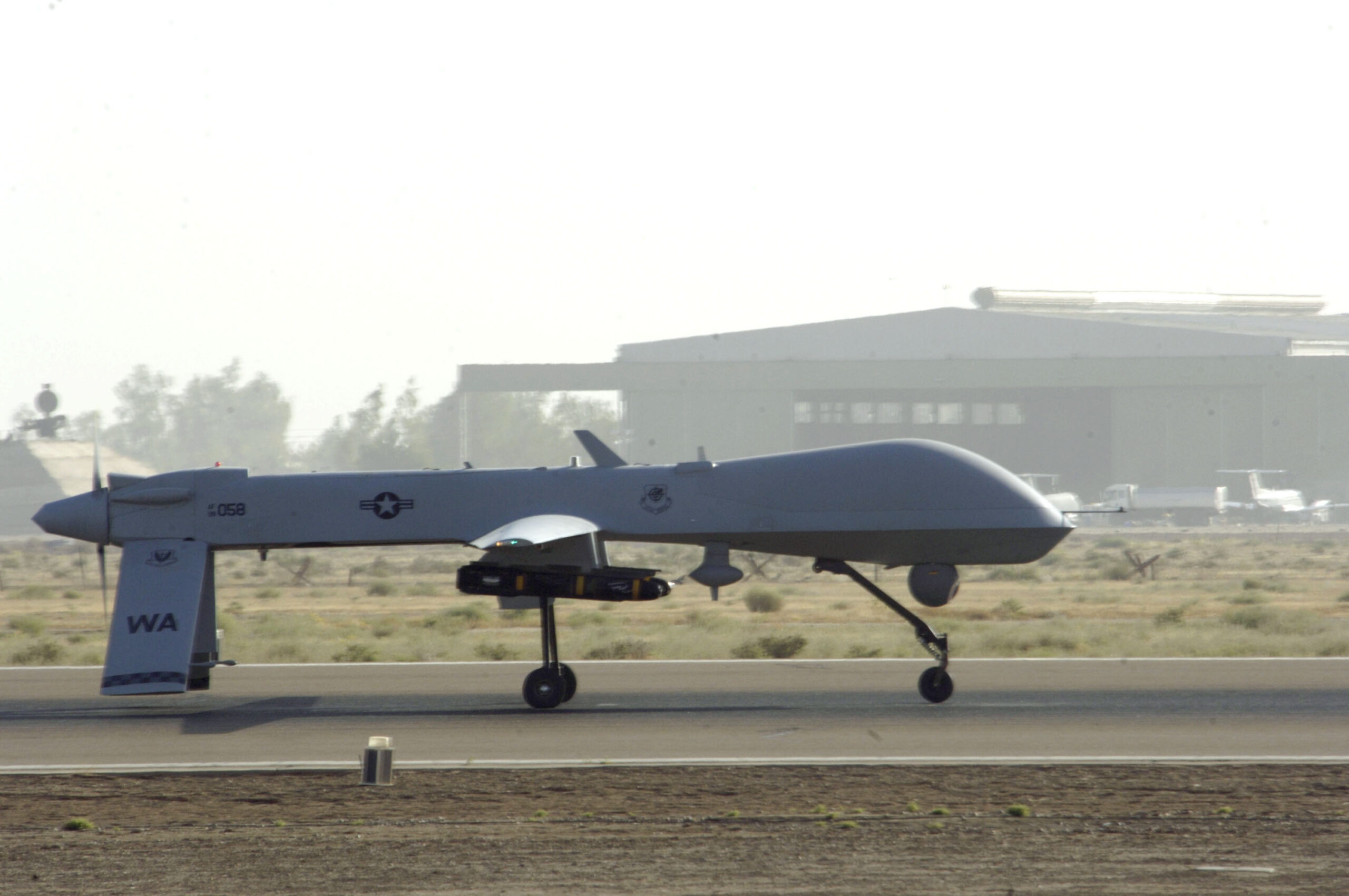
Cover image: U.S. Air Force MQ-1 Predator at Balad Air Base, June 14, 2006; photograph by Airman 1st Class Andrew Oquendo (U.S. public domain). Original image and rights.

Strategic Snapshot
The Predator wasn’t built to fire missiles.
When the RQ-1 entered military service in the 1990s, its primary mission was surveillance. It gave commanders a persistent view of activity on the ground, but the aircraft couldn’t directly engage the targets it observed.
That limitation helped drive one of the most consequential changes in modern unmanned aviation.
By adapting the Predator to carry Hellfire missiles, the U.S. military brought reconnaissance and strike capabilities onto the same platform. The development helped establish the armed remotely piloted aircraft model that would influence subsequent generations.
The real innovation, however, involved more than the aircraft.
Three Key Takeaways
1. Weaponization was a process, not a single breakthrough.
The Predator underwent weapons testing before entering armed operations in Afghanistan in October 2001. Its formal redesignation from RQ-1 to MQ-1 followed in 2002. Official historical accounts differ on an early Hellfire test date, but the broader sequence is documented.
2. The aircraft depended on an entire operational system.
Sensors, communications, ground crews, pilots, intelligence personnel, and commanders all contributed to the Predator’s expanded mission. Adding a missile created new capabilities, but it also required military organizations to adapt how those capabilities were employed.
3. Even influential technology eventually faces replacement.
The Air Force retired the MQ-1 in 2018 as it transitioned to the MQ-9 Reaper. The Predator’s success demonstrated the value of adapting an existing platform, but it did not make that platform indefinitely suitable for changing military requirements.
Why It Matters
The Predator’s history captures a recurring challenge in defense modernization.
An existing platform can gain a valuable new capability without becoming the best long-term investment. Engineering feasibility, operational effectiveness, supportability, and cost are separate questions.
The MQ-1 demonstrated how quickly the role of an aircraft could change. Its retirement reminds us that military innovation also involves knowing when an older system has reached its practical limits.
That is the enduring lesson: successful modernization depends on the mission, the supporting organization, and the alternatives available—not simply whether new equipment can be fitted to an existing platform.
Read the Full Article
Our full analysis, From RQ-1 to MQ-1: How Retrofitting the Predator Changed Modern Warfare, examines the historical transformation and its implications for modern defense technology.
Explore more analysis at https://thestrategiccurrent.com.
Recommended Resource
Smithsonian National Air and Space Museum — General Atomics MQ-1L Predator A
An original collection record covering the Predator’s development, weapons testing, and historical significance.
https://airandspace.si.edu/collection-objects/general-atomics-mq-1l-predator/nasm_A20040180000
More briefs coming soon, stay sharp.
Read more at https://thestrategiccurrent.com and follow The Strategic Current across our official platforms.