
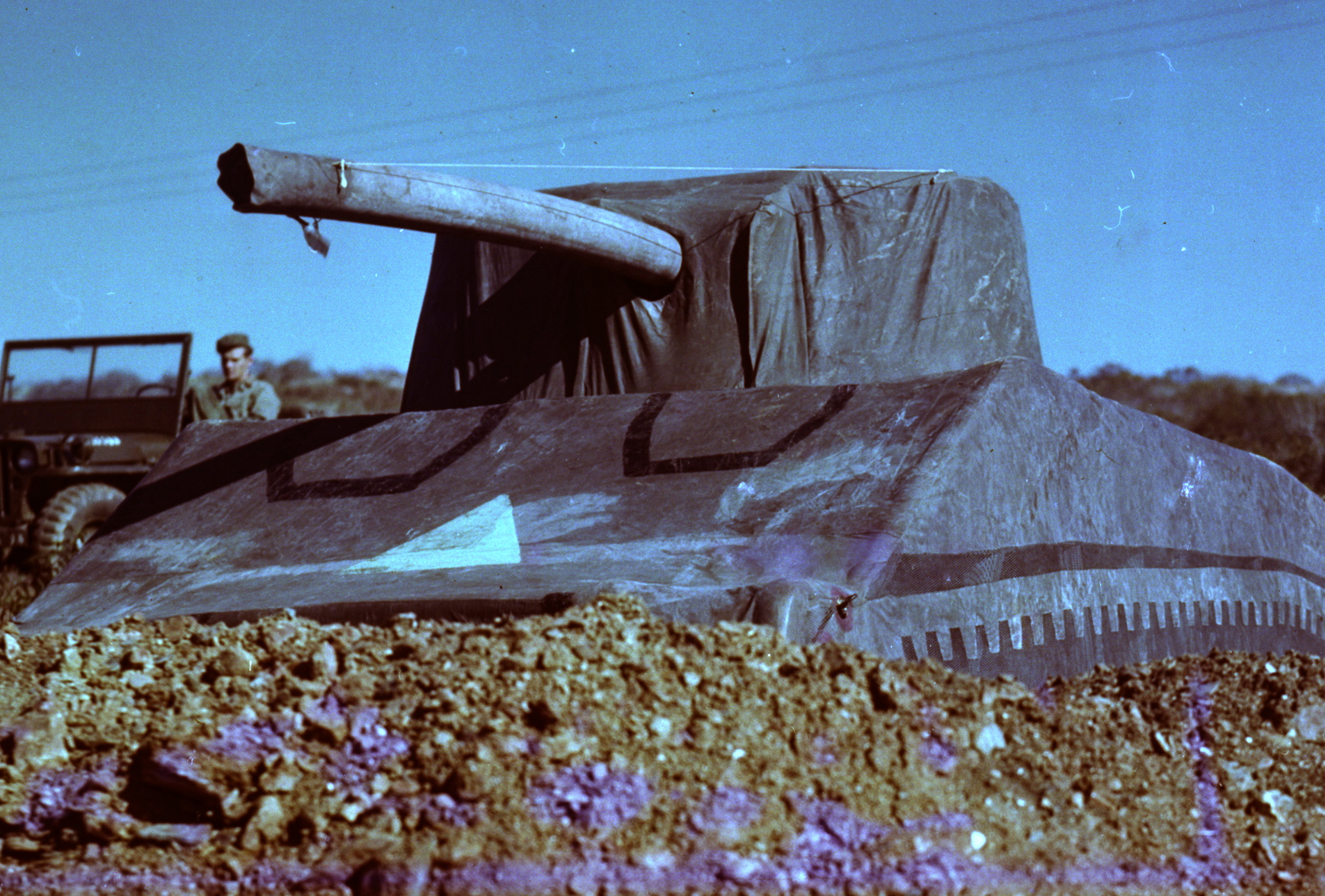
Cover photograph: A 93-pound inflatable decoy tank of the kind used by the Ghost Army during World War II. Courtesy: National Archives, via the Ghost Army press kit (original photograph). The source press kit identifies its historical photographs as cleared for media use; an individual National Archives catalog identifier was not provided.

In the summer of 1944, the United States Army sent a remarkable unit into France. Its mission was to make German forces believe that American divisions were operating in places where they were not.
The soldiers carried inflatable tanks, recorded battlefield sounds, created false radio traffic, and built convincing military positions. They wore the insignia of other units, staged vehicle movements, and impersonated officers from formations that were actually miles away.
Among them were art students, illustrators, designers, and men who would later become internationally recognized artists.
Their creative abilities were not incidental to the mission. They were among the reasons the unit existed.
Officially known as the 23rd Headquarters Special Troops, the approximately 1,100-man organization became famous as the Ghost Army. Between June 1944 and March 1945, it participated in more than 20 deception operations across Western Europe. Its job was to help conceal Allied movements, exaggerate American strength, and influence German assessments of where an attack might occur (Fox, 1945; Linn, 2020).
The Ghost Army did not win battles by itself. Its effectiveness depended on how well an illusion supported the movements and objectives of actual combat formations.
That distinction is what makes its history important.
The unit demonstrated that military innovation need not begin with a more powerful weapon. Sometimes the advantage comes from shaping what an adversary believes.
From art classrooms to military deception
Long before the Ghost Army reached Europe, American designers were exploring how artistic knowledge might be used in war.
In September 1940, Pratt Institute in Brooklyn established an Industrial Camouflage Program under James C. Boudreau, then dean of its School of Art. The program brought together art, architecture, industrial design, and military camouflage expertise to address a growing concern: how could important facilities be concealed from aircraft?
A factory might be difficult to recognize from the ground but conspicuous from the air. Shadows could reveal a building’s shape. The arrangement of roads or structures could make a military installation recognizable even when its surfaces were painted to blend with the surrounding landscape.
Pratt’s students examined these problems through models, field experiments, and observation from aircraft. They investigated ways to alter a structure’s apparent shape, disrupt its outline, and make artificial objects resemble their surroundings (Pratt Institute, 2020).
The work brought artistic judgment into a field where appearance could have immediate military consequences.
By 1944, several men associated with Pratt’s camouflage training had entered the 603rd Engineer Camouflage Battalion, which became a principal component of the Ghost Army.
One was Ellsworth Kelly.
Kelly studied at Pratt before entering the Army in 1943. He served with the 603rd and, after the war, became an influential figure in American abstract art. His wartime work placed him among soldiers who learned to manipulate color, form, and visual perception under operational conditions (Whitlock, 2026).
Other members included future fashion designer Bill Blass and photographer Art Kane.
Their backgrounds have sometimes encouraged a simplified description of the Ghost Army as a unit of art-school graduates. That is not quite accurate. Some members had attended art schools without completing their degrees before military service. Others were recruited for their experience in engineering, communications, advertising, or conventional military specialties.
The significance of the unit was not that every soldier possessed artistic training.
It was that the Army recognized how different kinds of expertise could be combined to accomplish a military objective.
Building an army that did not exist
The 23rd Headquarters Special Troops was activated at Camp Forrest, Tennessee, on January 20, 1944.
Its organization brought together several specialized elements. The 603rd Engineer Camouflage Battalion produced visual deception using inflatable vehicles, dummy equipment, and carefully arranged installations. The Signal Company Special simulated the communications traffic of military formations. The 3132nd Signal Service Company supplied sonic deception, playing recordings of vehicles and troop movements through powerful loudspeakers. The 406th Combat Engineer Company contributed security and engineering support (Fox, 1945; Ghost Army Congressional Gold Medal Act, 2022).
Each capability helped make the others believable.
An inflatable tank might resemble a genuine vehicle from a reconnaissance aircraft, but a group of tanks would be less convincing without evidence of the personnel and equipment normally accompanying an armored formation.
The Ghost Army therefore created entire military scenes.
Its soldiers arranged dummy vehicles in assembly areas, established simulated headquarters, displayed unit insignia, and generated radio communications consistent with the formations being portrayed. Sound trucks reproduced the movement of armored vehicles. Personnel visited nearby towns wearing the patches of units they were impersonating.
The purpose was to create a pattern of activity that enemy observers might interpret as evidence of a real formation.
That was a demanding assignment. German reconnaissance could rely on visual observation, radio interception, patrol reports, and other sources of information. A deception visible to one observer might be contradicted by another.
The Ghost Army’s task was to make the available clues support the same false conclusion.
Its methods combined artistic design with communications engineering, military discipline, and a practical understanding of what enemy intelligence might detect.
The result was more sophisticated than a collection of inflatable vehicles. It was a coordinated effort to influence an adversary’s assessment of American forces.
Brest: when a convincing illusion became dangerous
One of the Ghost Army’s first significant tests came during the siege of Brest, France, in August 1944.
American forces were trying to capture the heavily defended port city. The Ghost Army was assigned to exaggerate the apparent strength of the attacking formations and help draw German attention toward selected parts of the battlefield.
Between August 20 and 27, the unit brought visual, radio, and sonic deception together on an active front. It simulated elements of the 6th Armored Division, which had previously withdrawn from the area, using dummy tanks, fabricated communications, and recorded vehicle movements (Ghost Army Legacy Project, n.d.-d).
The operation demonstrated how persuasive the deception could become.
German artillery fire struck areas associated with the dummy positions. American observers regarded this attention as an indication that enemy forces were responding to the apparent armored presence.
But drawing enemy fire was not the same as ensuring that the deception supported the wider operation.
During the August 25 attack, Company D of the 709th Tank Battalion advanced near an area toward which the deception had helped concentrate German defenses. Five American tanks were knocked out by German anti-tank guns before reaching their intended line of departure.
The wartime history of the 406th Combat Engineer Company attributed the incident to a failure to appreciate how the deception had affected enemy dispositions. The Ghost Army Legacy Project’s later reconstruction likewise treats it as a serious coordination failure (Ghost Army Legacy Project, n.d.-b, n.d.-d).
The distinction matters. The Ghost Army had helped persuade German forces to pay attention to a particular area, but real American armor subsequently encountered the defenses concentrated there.
The episode exposed a danger inherent in battlefield deception.
If an illusion successfully changes enemy behavior, friendly commanders must account for that response. Otherwise, the deception may create unexpected hazards for the very forces it is intended to protect.
Brest did not bring about the hoped-for German surrender. It did, however, give the Ghost Army experience that would influence later operations.
The lesson was not simply how to build a more convincing false formation. It was how essential coordination became once the enemy began responding to it.
Bettembourg: concealing a vulnerable American line
In September 1944, the Ghost Army received a mission with more immediate defensive implications.
General George S. Patton’s Third Army was engaged around Metz. Farther north, a section of the American front near the Moselle River was thinly held, leaving commanders concerned that German forces might recognize the vulnerability.
The Ghost Army was ordered to make the sector appear more heavily defended.
During Operation Bettembourg, approximately 500 deception personnel impersonated elements of the 6th Armored Division—creating the impression of a force numbering roughly 8,000 soldiers (Ghost Army Legacy Project, n.d.-c).
The operation began on September 15, 1944.
The soldiers occupied positions around Bettembourg and neighboring areas of Luxembourg. They displayed false military markings, established simulated communications networks, used inflatable vehicles, and reproduced the sounds and activity associated with armored forces.
A convincing deception required more than equipment.
An actual division would generate traffic, communications, command activity, and signs of everyday military life. The Ghost Army tried to supply those details without possessing the formation it was pretending to represent.
The mission was especially hazardous because the sector was genuinely undermanned.
The deception personnel could make the American position look stronger, but they were not equipped to fight as the armored division they portrayed. If German forces had mounted a major attack against their positions, the illusion would have offered little protection.
What had been intended as a shorter operation continued for eight days as reinforcements were delayed.
The American line held. On September 22, elements of the 83rd Infantry Division were ready to assume the defense, allowing the Ghost Army to withdraw (Ghost Army Legacy Project, n.d.-c).
The operation was judged successful by American commanders and later historical accounts.
Even so, the available evidence does not establish that the Ghost Army alone prevented a German attack. The outcome also depended on the real troops holding the front, German operational choices, and the larger military situation.
Bettembourg illustrates a more defensible conclusion: deception could support a vulnerable position by making it difficult for an adversary to determine how much strength was actually present.
The soldiers could not create a real armored division.
They could create reasons for the enemy to believe one was there.
Viersen: deception before the Rhine crossing
The Ghost Army’s most ambitious operation came in March 1945 as Allied forces prepared to cross the Rhine River.
For the U.S. Ninth Army, the concentration of troops and the location of the intended crossing were information that German defenders needed to identify. Concealing the real assault preparations was therefore an important part of the operation.
The Ghost Army was assigned to help create a false picture of where American forces were assembling.
During Operation Viersen, conducted from March 18 to 24, the 23rd simulated the presence of the 30th and 79th Infantry Divisions in the XIII Corps area while the actual divisions assembled for the crossing in the XVI Corps sector.
The deception combined inflatable vehicles, radio transmissions, recorded sounds, and staged military activity. Other Ninth Army units supported the broader plan by concealing actual movements and creating additional indicators consistent with the false picture (Fox, 1945).
This was not a small deception force acting independently.
The 23rd’s contribution formed part of a coordinated effort involving real military formations, headquarters, artillery, engineers, and air support.
The operation also offers some of the most substantial evidence that the Ghost Army influenced German intelligence.
In his official unit history, Captain Fred Fox reported that intelligence personnel of the 79th Infantry Division obtained a captured German order-of-battle overlay shortly before the crossing. According to that account, the overlay placed the 79th near the area where the Ghost Army had simulated it and did not identify the 30th Infantry Division in its actual position.
Fox also recorded favorable assessments from Ninth Army intelligence officers, who believed the operation had materially contributed to concealing American dispositions and intentions.
These accounts are significant because they describe an identifiable intelligence effect rather than merely the successful construction of dummy equipment.
They also require careful attribution.
For this research packet, the underlying captured German overlay has not been independently examined. The available evidence is the wartime American account of what the overlay showed and how American intelligence officers interpreted it.
That supports a finding of reported deception success, not an unrestricted conclusion about everything German commanders believed or why they made particular decisions.
The Rhine crossing proceeded, and American officers credited the deception plan with helping preserve surprise.
The strongest historical judgment is that the Ghost Army made an important contribution to a larger, coordinated Ninth Army operation. It would overstate the evidence to suggest that inflatable tanks or the 23rd alone determined the outcome.
How much did the Ghost Army accomplish?
The Ghost Army is often credited with saving thousands of Allied lives.
The claim reflects a reasonable military proposition. If deception causes defenders to reinforce the wrong sector, delays an attack, or conceals the actual concentration of troops, it may reduce the casualties sustained by friendly forces.
The Ghost Army Congressional Gold Medal Act recognizes that the deception units contributed to Allied victories and reduced casualties (Ghost Army Congressional Gold Medal Act, 2022).
But a general recognition of casualty reduction is different from an independently established numerical estimate.
To calculate how many lives were saved, researchers would need to reconstruct what German forces would otherwise have done, how American operations would have unfolded without deception, and how those different decisions would have affected casualties.
The surviving records do not provide a complete basis for that calculation.
What they do provide is a history of more than 20 deception operations and a number of documented attempts to influence enemy perceptions. The National WWII Museum counts 22 operations, while the congressional legislation identifies 21 full-scale tactical deceptions. Because the two records use different classifications, the cautious description is more than 20 operations rather than presenting either count as universally definitive (Linn, 2020; Ghost Army Congressional Gold Medal Act, 2022).
Individual missions provide a clearer way to evaluate the unit’s contribution.
At Brest, the deception attracted German attention but was associated with a serious coordination failure. At Bettembourg, it helped conceal a thinly defended sector until reinforcements arrived. At Viersen, American records describe captured intelligence material consistent with part of the false order of battle.
These are meaningful but different outcomes.
Deception can attract attention without achieving its intended objective. It can influence an enemy assessment without determining an entire battle. It can support military success without permitting historians to assign it sole credit.
Recognizing those distinctions does not diminish the Ghost Army.
It gives a more accurate account of what the soldiers accomplished—and what the surviving evidence can establish.
The long road from secrecy to recognition
After World War II, the Ghost Army’s work remained largely outside the public narrative of the European campaign.
Its missions were secret, and important records remained classified for decades.
The history was not completely absent from public discussion. Limited reporting appeared shortly after the war, and additional accounts emerged during the 1980s. Nevertheless, the unit’s official history was not declassified until 1996, long after many veterans had returned to civilian life (Fox, 1945; Linn, 2020).
Declassification made it easier for historians, museums, veterans, and researchers to examine the unit’s activities in detail.
It also helped distinguish the actual military record from the more colorful stories that had circulated about inflatable tanks and theatrical battlefield tricks.
Official recognition eventually followed.
On February 1, 2022, the Ghost Army Congressional Gold Medal Act became law. It authorized a Congressional Gold Medal recognizing the 23rd Headquarters Special Troops and the separate 3133rd Signal Service Company, which conducted deception operations in Italy.
The distinction between these units is important.
The 3132nd Signal Service Company was part of the 23rd and supported its sonic deception activities in northwestern Europe. The 3133rd Signal Service Company was a separate organization whose wartime service was also recognized by Congress.
The Congressional Gold Medal was presented at the U.S. Capitol on March 21, 2024. Surviving veterans participated in the ceremony alongside military and congressional leaders (Army University Press, 2024).
For men whose wartime assignments had required secrecy, the ceremony represented an unusually public acknowledgment of their service.
The recognition also reflected a broader understanding of military contribution.
The Ghost Army had not been organized to seize territory or destroy enemy formations directly. Its purpose was to influence what an opponent believed, creating opportunities for other American forces.
That mission was less visible than conventional combat, but it was part of the campaign’s operational history.
The strategic value of a convincing illusion
The Ghost Army did not invent the concept of battlefield deception.
Camouflage, dummy equipment, misleading communications, and false troop movements had long been used in warfare.
What distinguished the 23rd Headquarters Special Troops was the degree to which it combined these techniques into a specialized, mobile capability.
Artists understood how objects appeared from different distances and perspectives. Communications specialists knew what realistic military radio traffic should resemble. Sound crews could reproduce the audible signature of troop and vehicle movements. Engineers and security personnel helped place those effects in operating areas where mistakes carried real consequences.
Together, they produced an illusion that had to withstand more than a passing glance.
The military significance lay in the relationship between these specialties and the operational plan they supported.
An inflatable tank was a convincing object only under the right circumstances. An apparent division became a useful deception when its location, communications, and activity served a particular military purpose.
That is why coordination mattered as much as creativity.
The Ghost Army’s experience also reveals a persistent problem in intelligence analysis: information can be accurate as an observation while misleading as an interpretation.
A reconnaissance aircraft might correctly report vehicles in a field. An intercepted transmission might genuinely originate from a radio station. A patrol might accurately observe soldiers wearing a recognizable unit insignia.
Yet the conclusion drawn from those observations—that a particular division was present—could still be wrong.
The Ghost Army deliberately exploited that gap between observed activity and inferred military strength.
The principle remains relevant, even though modern forces possess surveillance and analytical capabilities far beyond those available in 1944.
More sophisticated sensors can expand what commanders detect. They do not automatically eliminate the possibility that the signals being detected were deliberately constructed to deceive them.
The lasting lesson is therefore not that creativity can replace military capability.
It is that creative and technical expertise, when integrated with disciplined military planning, can shape how an adversary understands the battlefield.
Conclusion: the soldiers who made armies appear
The Ghost Army demonstrated how a comparatively small organization could contribute to major military operations by influencing what an enemy believed.
Its soldiers constructed false armored formations, generated fabricated communications, and staged the sounds and movements of forces that were not actually present.
Artists helped make those illusions convincing, but their work depended on radio operators, engineers, security personnel, and commanders who understood how deception supported an operational objective.
The unit’s experience was not a sequence of effortless successes.
Brest demonstrated the dangers of poor coordination. Bettembourg showed the value of disguising a vulnerable position. Viersen provided evidence that a coordinated deception could influence the enemy’s reported understanding of American dispositions.
Together, those operations show what made the Ghost Army valuable—and why its achievements require more careful examination than dramatic stories about inflatable tanks alone.
Its historical contribution was not simply that art students helped trick German forces.
It was that the U.S. Army brought together artistic judgment, technical knowledge, and military planning to create a capability that changed how an adversary perceived the battlefield.
The Ghost Army’s legacy is a reminder that military advantage sometimes comes not from the force an army possesses, but from what its opponent can be persuaded to believe.
Continue the analysis
Read more evidence-based reporting on military history, intelligence, defense technology, and strategic affairs at The Strategic Current.
Follow The Strategic Current across our official platforms for further analysis.
Sources and Additional Information
Army University Press. (2024). Ghost Army honored. Military Review. https://www.armyupress.army.mil/Journals/Military-Review/English-Edition-Archives/May-June-2024/Cover-3/
Fox, F. (1945, September). Official history of the 23rd Headquarters Special Troops [U.S. Army unit history; declassified in 1996; online transcription prepared in 2018]. National Archives, Record Group 407, SPHQ-23. Ghost Army Legacy Project. https://ghostarmy.org/thearchive/Official-History-of-the-23rd/intro/
Ghost Army Congressional Gold Medal Act, Pub. L. No. 117-85, 136 Stat. 11 (2022). https://www.congress.gov/117/plaws/publ85/PLAW-117publ85.pdf
Ghost Army Legacy Project. (n.d.-a). 23rd Headquarters Special Troops. https://ghostarmy.org/about/23rd-headquarters-special-troops/
Ghost Army Legacy Project. (n.d.-b). History of the 406th: Operation Brest [Wartime unit-history transcription]. https://ghostarmy.org/thearchive/history-406th-operation-brest/
Ghost Army Legacy Project. (n.d.-c). Operation Bettembourg. https://ghostarmy.org/about/operation-bettembourg/
Ghost Army Legacy Project. (n.d.-d). Operation Brest. https://ghostarmy.org/about/operation-brest/
Linn, J. (2020, March 31). New museum exhibit reveals secrets of World War II’s “Ghost Army.” The National WWII Museum. https://www.nationalww2museum.org/war/articles/wwii-museum-exhibit-ghost-army
Pratt Institute. (2020, May 5). A look back: How Pratt students and faculty designed for deception in World War II. https://www.pratt.edu/news/a-look-back-how-pratt-students-and-faculty-designed-for-deception-in-world/
Whitlock, A. (2026, May 6). The Ghost Army’s artists at war. National Gallery of Art. https://www.nga.gov/stories/articles/ghost-armys-artists-war
AI Disclosure
AI-Assisted Content Disclosure: This article was prepared with the assistance of generative artificial intelligence. AI was used to help organize, draft, edit, and refine the article based on the supplied research materials. The underlying research and sources are identified in the article and its editorial record. AI assistance does not constitute an endorsement by any source, institution, or individual referenced in this article.
AI limitations: While care was taken to verify information, AI tools can introduce errors; readers are encouraged to consult original sources. If any discrepancies in this information are identified, please email [email protected] for immediate correction.
U.S. Copyright Office. Copyright and Artificial Intelligence: Part 2—Copyrightability. https://www.copyright.gov/ai/
Copyright and editorial attribution
© 2026 The Strategic Current. All rights reserved. This notice applies to eligible original editorial material and does not claim ownership of cited third-party sources, archival documents, images, or other separately owned material.