
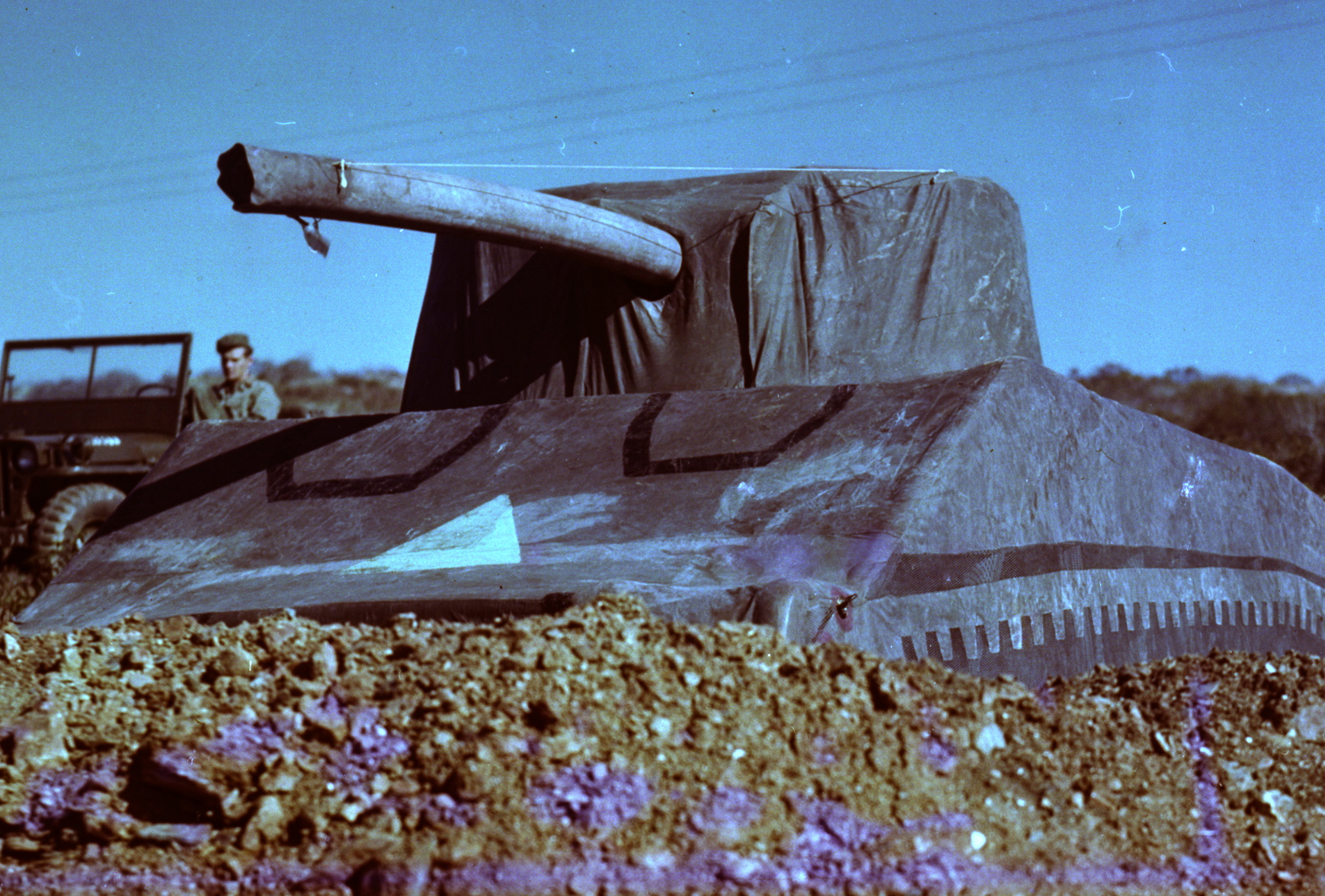
Cover image: Inflatable decoy tank of the kind used by the Ghost Army. National Archives photograph via the Ghost Army press kit; the press kit identifies photographs as cleared for media use. Original image.

Strategic Snapshot
In 1944, the U.S. Army sent an unusual unit into Europe. Its mission was to make German forces believe American divisions were operating where they did not actually exist.
Known as the Ghost Army, the approximately 1,100-man 23rd Headquarters Special Troops included artists, designers, engineers, and communications specialists. Its soldiers deployed inflatable tanks, simulated radio networks, recorded military sounds, and staged convincing troop movements.
Their objective was not to defeat German formations directly. It was to influence enemy intelligence, conceal real American movements, and create uncertainty about Allied strength.
The Ghost Army’s effectiveness depended on something more consequential than realistic equipment: making several different forms of deception support the same military objective.
Three Key Takeaways
1. Artistic skills became military capabilities.
The Ghost Army included men trained in camouflage, illustration, and visual design. Some had studied at institutions such as Pratt Institute. Working alongside engineers and signal specialists, they helped create the appearance of military formations that were not actually present.
2. A convincing illusion could influence battlefield decisions.
During Operation Bettembourg in September 1944, roughly 500 deception personnel simulated elements of an armored division to help conceal a vulnerable American sector. In March 1945, Operation Viersen supported a larger deception effort ahead of the Rhine crossing. American wartime records reported evidence that German intelligence accepted parts of the false picture.
3. Deception was powerful, but its effects had limits.
At Brest, an earlier operation demonstrated how misleading the enemy could create dangers for friendly forces when coordination failed. Although the Ghost Army is often credited with saving lives, the surviving evidence does not establish a precise casualty total attributable to its operations.
Why It Matters
The Ghost Army offers a lesson that extends beyond World War II.
Military advantage does not always depend on possessing more troops or better weapons. It can also come from influencing how an adversary interprets available information.
A reconnaissance report may accurately identify vehicles. A radio intercept may capture genuine transmissions. Yet the conclusion drawn from those observations can still be wrong if the activity was deliberately staged.
The Ghost Army exploited that distinction through coordinated visual, sonic, and communications deception.
Its history demonstrates the value of combining creativity, technical expertise, and disciplined military planning. It also shows why successful deception must be judged by its operational effects—not simply by how convincing the illusion appeared.
The strategic lesson: Information superiority requires more than collecting accurate observations. It also requires understanding whether those observations represent what they appear to show.
Read the Full Article
Our full analysis, The Ghost Army: How Artists Helped Deceive Nazi Germany, examines the unit’s formation, its operations at Brest, Bettembourg, and Viersen, and the evidence behind its wartime achievements.
Recommended Resource
Ghost Army Legacy Project — Official History of the 23rd Headquarters Special Troops
A transcription of Captain Fred Fox’s September 1945 unit history, documenting the organization’s structure, missions, and wartime assessments. The document was declassified in 1996.
https://ghostarmy.org/thearchive/Official-History-of-the-23rd/intro/
More briefs coming soon, stay sharp.
Read more at https://thestrategiccurrent.com and follow The Strategic Current across our official platforms.