
Introduction
At Desert One, a U.S. rescue force was preparing to withdraw when a helicopter collided with a C–130 transport aircraft. Eight crew members died. The attempt to rescue American hostages in Tehran had already been aborted: only five helicopters were operational, one fewer than the minimum needed to continue. The after-action report is explicit about that order of events (After action report, n.d.).
The distinction changes how the operation should be assessed. Equipment shortfalls stopped the planned rescue; the loss of life came during the effort to leave. The official records illuminate the decisions leading to each event, but cannot tell us whether the unexecuted phases would have succeeded (After action report, n.d.).
This account draws on six original U.S. records: internal deliberations, pre-mission intelligence, the operational report, a diplomatic telegram, a later oversight meeting, and President Jimmy Carter’s public remarks. Together they show how U.S. officials planned, halted, and explained Eagle Claw. They cannot independently establish how Iranian officials understood the mission or whether the two governments possessed the same information (Carter, 1980; U.S. Department of State, 1980).
Background
At the April 11 National Security Council meeting, Carter described the prospects for hostage release as remote and asked advisers to assess alternatives. Participants discussed economic restrictions, military pressure, and rescue. Several argued that blockade or mining options would not resolve the hostage issue, while Carter concluded that preparations for rescue should move quickly, targeting April 24 if ready. The minutes thus document urgency coupled with a readiness qualification, rather than an unconditional calendar deadline (Minutes of a National Security Council meeting, 1980).
Secrecy was part of the plan from the outset. Carter urged keeping the rescue clandestine even within parts of the White House, while advisers discussed possible deception measures. That priority would later collide with congressional demands for an explanation of the operation. The minutes document the secrecy decision; they do not show that it caused the failure (Minutes of a National Security Council meeting, 1980).
According to the undated after-action report, planning advanced through readiness and command reviews, with the Joint Chiefs and president approving the plan on April 16. April 24 remained the planning date, subject to an execution, delay, or cancellation decision based on conditions. These steps distinguish authorization to prepare from an irrevocable commitment to continue regardless of circumstances (After action report, n.d.).
Intelligence available on April 24 was useful but qualified. A telegram tentatively placed four to five hostages in the Ambassador’s residence and acknowledged uncertainty about their exact location inside it. It also reported hostages in embassy offices, but its redactions and explicit qualifications prevent reading it as a confirmed inventory. The appropriate conclusion is that planners possessed reported location information with unresolved gaps, not that they either knew everything necessary or lacked all actionable intelligence (ALFA/J–2, 1980).

Analysis
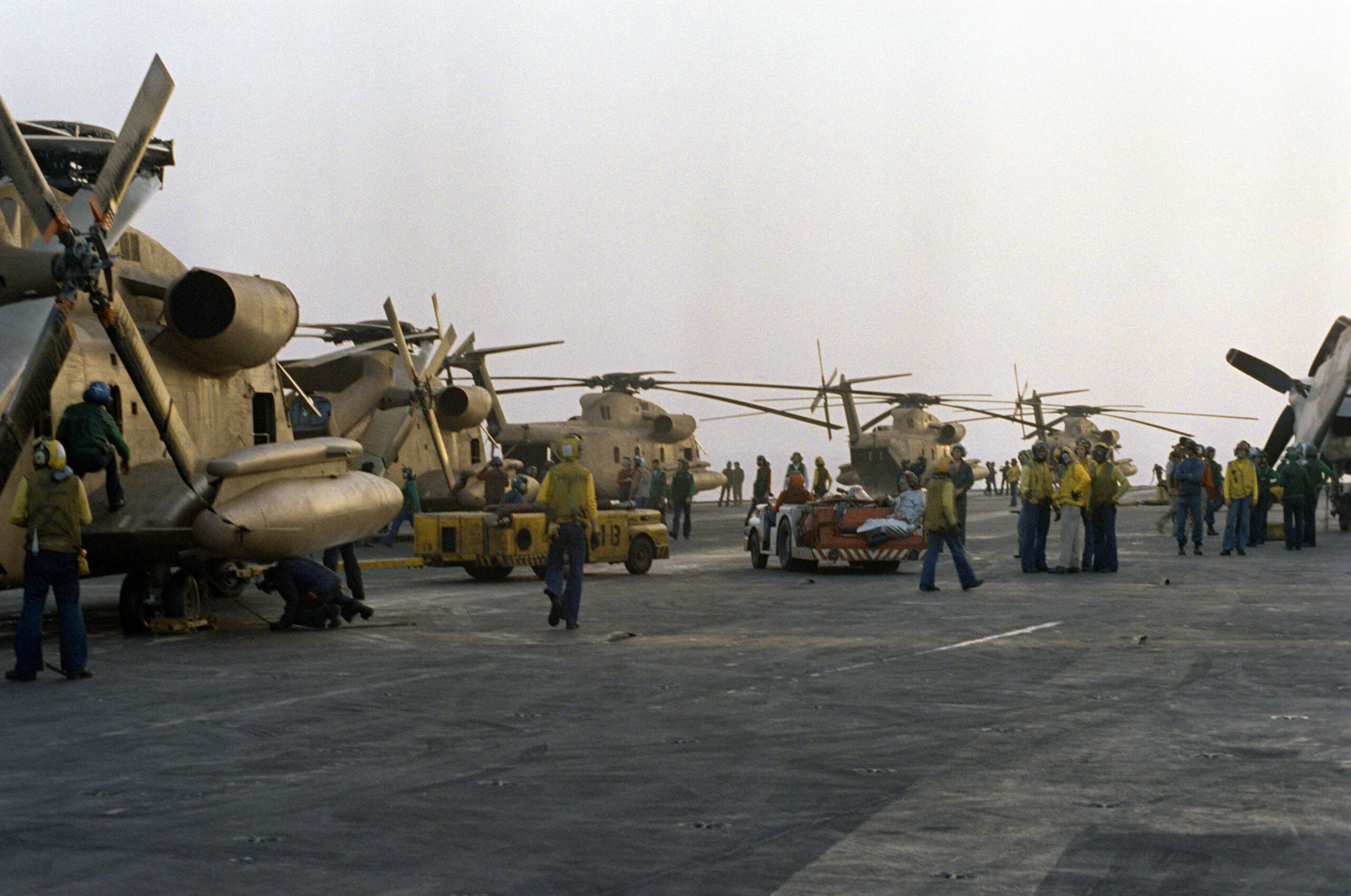
The operational report describes eight helicopters departing the carrier Nimitz for Desert One on the evening of April 24. One landed after indications of impending rotor-blade failure, and its crew transferred to another helicopter. The formation subsequently encountered unexpected suspended dust. Another helicopter suffered failures of critical navigation and flight instruments amid deteriorating visibility and returned to the carrier. Six helicopters eventually reached the refueling site, approximately 50 to 85 minutes later than planned (After action report, n.d.).
Arrival did not mean availability. A helicopter that reached Desert One with a partial hydraulic failure could not be repaired there. The report states that a replacement pump was unavailable and that, even with one immediately available, repairs and servicing would leave insufficient time to complete the next leg before daylight. The helicopter was considered unsafe to continue unrepaired. This account identifies interacting equipment, time, and environmental constraints rather than one isolated malfunction (After action report, n.d.).
The governing threshold was a minimum of six operational helicopters at the refueling site. Only five remained operational. The on-scene commander reported the situation, the joint task force commander communicated his intention to abort, and Carter concurred. Withdrawal preparations then began. The report supports the narrow inference that a previously established continuation criterion was applied; it does not independently demonstrate whether that criterion or the original force allocation was optimal (After action report, n.d.).
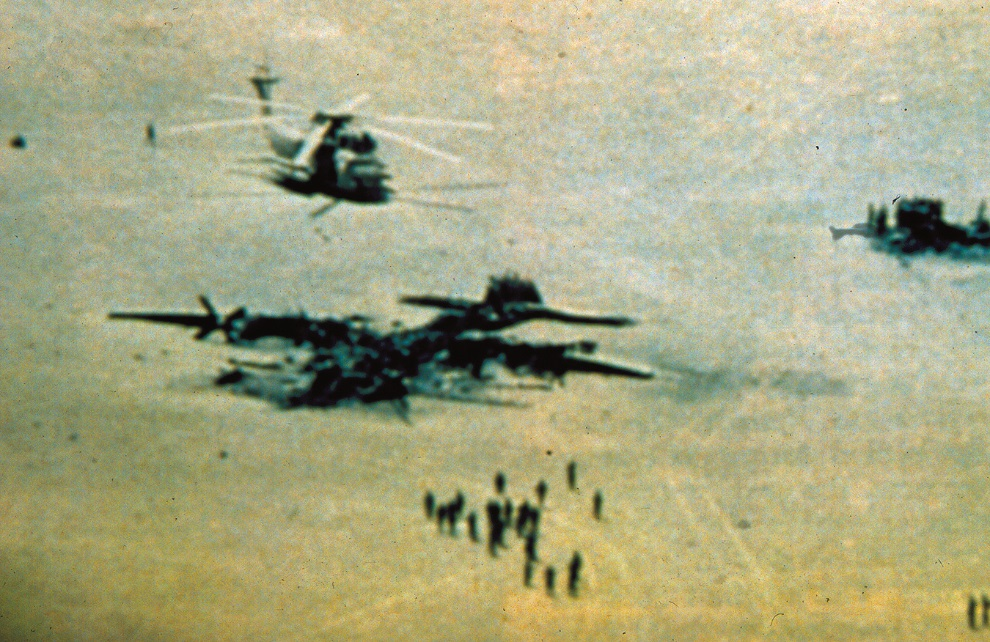
During those preparations, a helicopter being repositioned to permit another to refuel collided with a C–130. Both aircraft caught fire, killing eight crew members and injuring five other team members. The report describes evacuation from the burning aircraft, exploding ammunition, and damage to nearby helicopters before the remaining personnel departed aboard C–130s. Cancellation had ended the attempt to proceed, but it had not ended exposure to operational danger (After action report, n.d.).
The diplomatic explanation was less precise. An April 25 State Department telegram described cancellation as resulting from a malfunction and an aircraft accident. The after-action report and Carter’s public address place the abort decision before the collision. That difference is visible in the sources; the available documents do not establish whether it resulted from hurried composition, incomplete information, or another cause (After action report, n.d.; Carter, 1980; U.S. Department of State, 1980).
Strategic Implications
Washington also wanted to define the mission’s purpose. The April 25 telegram instructed U.S. representatives to ask Swiss intermediaries to convey a message to Iranian leaders describing hostage release as the sole objective and denying hostility toward Iran. The telegram establishes the requested communication, not proof of its delivery. Carter likewise described the operation publicly as a humanitarian rescue. Both statements reveal the U.S. explanation; neither establishes the Iranian response (Carter, 1980; U.S. Department of State, 1980).
The two accounts also made different casualty claims. The diplomatic telegram qualified its statement about Iranian casualties by limiting it to what U.S. officials then knew; Carter’s address said categorically that none had occurred. Without an independent Iranian or forensic account, neither statement should be presented as a settled finding about all effects on the ground (Carter, 1980; U.S. Department of State, 1980).
Carter publicly assumed responsibility for both attempting and cancelling the operation. That statement identifies his declared political responsibility, while the operational report describes a command process in which the shortfall was reported upward and the president concurred in the abort. These accounts need not be treated as competing descriptions: one addresses responsibility before the public, the other the sequence of operational recommendation and concurrence (After action report, n.d.; Carter, 1980).
By May 6, internal deliberations recorded increasing congressional pressure over restrictions on discussing activities beyond Phase I, which extended through Desert One. The Special Coordination Committee reported that leaks were undermining the credibility of withholding information and sought presidential reconsideration. It also identified specific details members believed should remain protected. The strategic tension was therefore not simply secrecy versus complete disclosure, but how to reconcile selective protection with oversight and credibility after an unsuccessful operation (Summary of conclusions of a Special Coordination Committee meeting, 1980).
The committee summary also recorded congressional claims to a right of information and concern that restricted access could lead to funding retaliation. Those were reported positions and possible consequences, not a judicial finding or evidence that funding was cut. Even as operational questions remained unresolved, oversight and public confidence had become matters for the administration to manage (Summary of conclusions of a Special Coordination Committee meeting, 1980).
Lessons Learned
Treat intelligence estimates as estimates. The April 24 telegram contained tentative hostage numbers, uncertainty about positions inside a residence, and redacted passages. Such reports can help commanders prepare, but later accounts should not convert them into confirmed facts merely because the operation is now historical (ALFA/J–2, 1980).
Plan the withdrawal as carefully as the advance. The force followed its six-helicopter continuation threshold, yet the fatal collision occurred after the decision to leave. That chronology makes withdrawal procedures a legitimate subject of review. It cannot prove that a specific alternative maneuver would have prevented the accident (After action report, n.d.).
Compare records according to their purpose. The operational report describes the decision chain, Carter’s address accepts political responsibility, and the telegram explains U.S. intentions to a foreign audience. Taken together, they show different parts of the same episode without turning a diplomatic claim into an operational finding (After action report, n.d.; Carter, 1980; U.S. Department of State, 1980).
Reassess secrecy after an operation ends. The May 6 summary describes leaks, congressional demands, and a request to reconsider limits on disclosure about later mission phases. It offers a contemporaneous example of security concerns and oversight needs coming into conflict. It does not establish how all subsequent disclosure disputes were resolved (Summary of conclusions of a Special Coordination Committee meeting, 1980).
Conclusion
Eagle Claw illustrates how an operation can be cancelled for one set of reasons and still suffer catastrophic losses in the process of disengaging. The record is clear on the sequence: helicopter availability fell below the six-aircraft threshold, commanders moved to abort, Carter concurred, and the collision followed during withdrawal preparations (After action report, n.d.).
What followed was a second challenge: explain the attempt without collapsing operational chronology, diplomatic purpose, and public accountability into one official story. The record captures those different perspectives and their limits. It leaves unanswered how Iranian observers understood the mission and whether the unexecuted stages might have succeeded. For readers and decision-makers alike, the lesson is to distinguish a documented action from an interpretation offered after the fact (Carter, 1980; Summary of conclusions of a Special Coordination Committee meeting, 1980; U.S. Department of State, 1980).
Sources and Additional Information
After action report [Document 267]. (n.d.). In Foreign relations of the United States, 1977–1980, Volume XI, Part 1: Iran, hostage crisis, November 1979–September 1980. U.S. Department of State, Office of the Historian. https://history.state.gov/historicaldocuments/frus1977-80v11p1/d267
ALFA/J–2. (1980, April 24). Telegram from ALFA/J–2 to the Joint Task Force intelligence officer (Mattingly) aboard the U.S.S. Nimitz [Document 264]. In Foreign relations of the United States, 1977–1980, Volume XI, Part 1: Iran, hostage crisis, November 1979–September 1980. U.S. Department of State, Office of the Historian. https://history.state.gov/historicaldocuments/frus1977-80v11p1/d264
Carter, J. (1980, April 25). Address to the nation on the rescue attempt for American hostages in Iran. The American Presidency Project. https://www.presidency.ucsb.edu/documents/address-the-nation-the-rescue-attempt-for-american-hostages-iran
Minutes of a National Security Council meeting [Document 250]. (1980, April 11). In Foreign relations of the United States, 1977–1980, Volume XI, Part 1: Iran, hostage crisis, November 1979–September 1980. U.S. Department of State, Office of the Historian. https://history.state.gov/historicaldocuments/frus1977-80v11p1/d250
Summary of conclusions of a Special Coordination Committee meeting [Document 277]. (1980, May 6). In Foreign relations of the United States, 1977–1980, Volume XI, Part 1: Iran, hostage crisis, November 1979–September 1980. U.S. Department of State, Office of the Historian. https://history.state.gov/historicaldocuments/frus1977-80v11p1/d277
U.S. Department of State. (1980, April 25). Telegram from the Department of State to the Embassy in Switzerland [Document 268]. In Foreign relations of the United States, 1977–1980, Volume XI, Part 1: Iran, hostage crisis, November 1979–September 1980. U.S. Department of State, Office of the Historian. https://history.state.gov/historicaldocuments/frus1977-80v11p1/d268
Historical image credits
Featured photograph: Desert One, Iran, April 1980, showing wreckage after Operation Eagle Claw. U.S. military / U.S. Special Operations Command (public domain). Source and rights record. In-article photograph: U.S. Navy crews and RH-53 helicopters aboard USS Nimitz, April 24, 1980. U.S. Navy / National Archives, NAID 6349110 (public domain). Source and rights record. These are contemporary photographs, not AI reconstructions.

Continue the analysis
Read more evidence-based analysis of military history, intelligence, and national security at The Strategic Current. Follow the publication for future investigations grounded in primary records.
AI Disclosure
This article originated from a supervised AI-assisted drafting and machine-QA process using identified historical sources. The Strategic Current is responsible for its editorial review, factual verification, rights decisions, and publication. No AI tool is represented as an independent historical source, author, or approving editor.
AI systems can introduce factual or attribution errors. Readers should consult the linked original documents; potential corrections may be directed to [email protected].
Additional rights guidance: U.S. Copyright Office, Copyright and Artificial Intelligence: Part 2—Copyrightability. https://www.copyright.gov/ai/
Copyright and editorial attribution
© 2026 The Strategic Current. Copyright applies only to eligible original editorial material. Cited government, archival, and third-party materials retain their separate rights or public-domain status as applicable.