
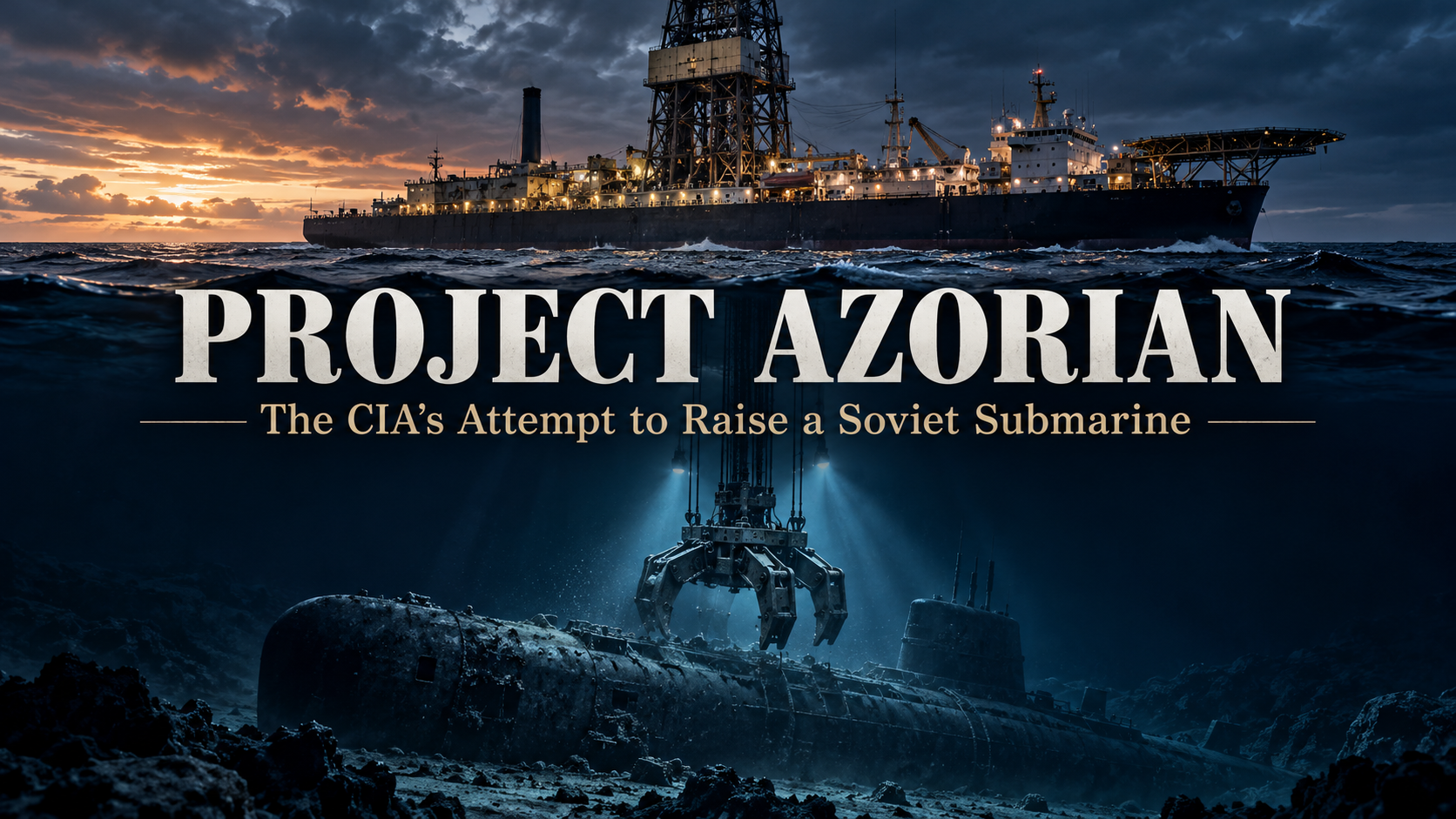
Cover image: AI-generated editorial illustration created for The Strategic Current; artistic reconstruction, not an archival photograph of Project Azorian. AI and editorial technology information.
Strategic Snapshot
In 1974, the CIA used the Hughes Glomar Explorer, presented publicly as an experimental deep-sea mining ship, to attempt the recovery of the Soviet ballistic-missile submarine K-129. The wreck lay roughly 16,500 feet beneath the Pacific. The ship recovered part of the submarine, but a substantial section broke away during the lift. How much useful intelligence the United States ultimately obtained remains incompletely public (CIA, n.d.; Minutes of a National Security Council meeting, 1974).
Project Azorian is not simply a story about a giant mechanical claw. It is a case study in the difference between an ambitious intelligence objective, an extraordinary engineering achievement, and an intelligence outcome that cannot be fully reconstructed from declassified records.
Three Key Takeaways
1. An intelligence target is not a confirmed recovery. A May 1974 U.S. assessment described hoped-for cryptographic materials, missile technology, and documents, expressly assuming a successful mission (Colby, 1974).
2. The partial lift is documented. In an August 10 briefing, CIA Director William Colby told President Ford that the capture equipment had been damaged and a portion of the submarine had been lost. The remaining section was aboard the recovery ship, but its contents were not yet fully assessed (Minutes of a National Security Council meeting, 1974).
3. Technical success and intelligence success are different measures. The American Society of Mechanical Engineers later recognized the vessel’s innovations, while a participant’s 2025 account questioned the intelligence yield (ASME, n.d.; Newman, 2025).
Why It Matters
Azorian shows how intelligence collection can depend on private industry, complex engineering, and a credible operational disguise. It also exposes a recurring analytical error: presenting expected gains as verified results. The stronger historical judgment is that the physical recovery was partial and the precise intelligence payoff remains uncertain—not that either total triumph or total failure has been established.
Its publicity after 1974 also demonstrates how quickly the exposure of a covert capability can remove the chance for a second attempt. Evidence from the operation continues to reward a distinction between what was planned, what was lifted, and what can actually be proved (Aid et al., 2010).
Read the Full Article
Project Azorian: The CIA’s Attempt to Raise a Soviet Submarine.
Recommended Resource
U.S. Department of State, Foreign Relations of the United States, Document 185: William Colby’s May 23, 1974 memorandum on the anticipated intelligence value of Project Azorian. Read the original memorandum.
More briefs coming soon, stay sharp.
Read more at https://thestrategiccurrent.com and follow The Strategic Current across all platforms.